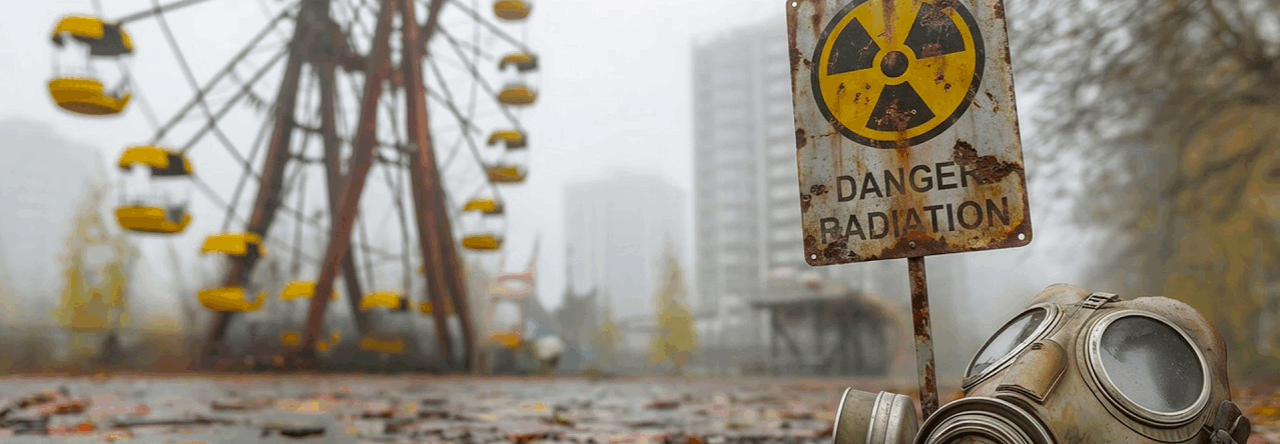
Pripyat is a legendary ghost city in Chernobyl’s exclusion zone, built in 1970 to house the workers of the Chernobyl Nuclear Power Plant and their families. In 1986, after the explosion at the plant, the city was evacuated and vanished from the map of living towns, becoming a symbol of loss and one of the most discussed tragedies of the twentieth century.
I come from the Bryansk region, a large borderland between Ukraine and Belarus where the history of Chernobyl has become deeply personal for many people. Scientific and medical studies have shown that parts of Bryansk were contaminated by radioactive fallout; in some areas food and health were strictly monitored, and conversations about Chernobyl became part of everyday family life, especially in the southern and eastern districts. These consequences are not just official statistics, but also memories, documents, photographs and oral stories that people continue to share decades later.
In my family and among friends, questions about that time have always felt especially important, yet with every year memories fade, are retold in fragments, and disappear together with the older generations. I want to give these voices a place in our shared memory: to collect stories, photographs and personal testimonies so that the tragedy does not remain just a dry date in a textbook.
This blog is an attempt to bring together official accounts and personal narratives of this catastrophe and to show how digital technologies can help preserve a truthful picture of the past and allow us to engage with these crucial moments in history once again.
Pripyat’s history before 1986
Pripyat was founded in February 1970 in northern Ukraine, just a few kilometres from the future Chernobyl Nuclear Power Plant. The new city was conceived as a model Soviet project – modern, functional and bright. It was built for plant workers and their families, with high salaries, new apartments, schools, hospitals, cultural centres, an amusement park and even its own riverside promenade.
Life there felt dynamic and full of promise. Young specialists were drawn by comfortable housing, sports facilities, cinemas, shops and convenient transport. New residential blocks and public spaces kept appearing, trees were planted, children’s and cultural clubs were opened, and local factories and workshops were in constant operation.
Pripyat was a city of intellectuals. You could feel it just walking down the street – in the way people talked, in the rhythm of life… I arrived there after university and was struck by the atmosphere: comfort, cleanliness, cultured people.
Anatoly Besedin
Dozens of photographs from the Soviet period show clean streets, smiling children, public celebrations, parades, opening ceremonies and cheerful faces near the Ferris wheel. In the memories of residents, Pripyat was perceived as a city of the future – safe, modern and urbanistically advanced.
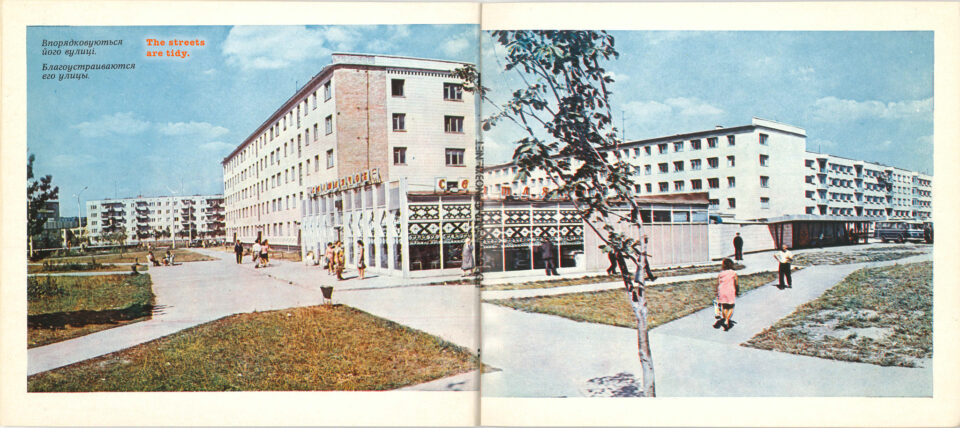


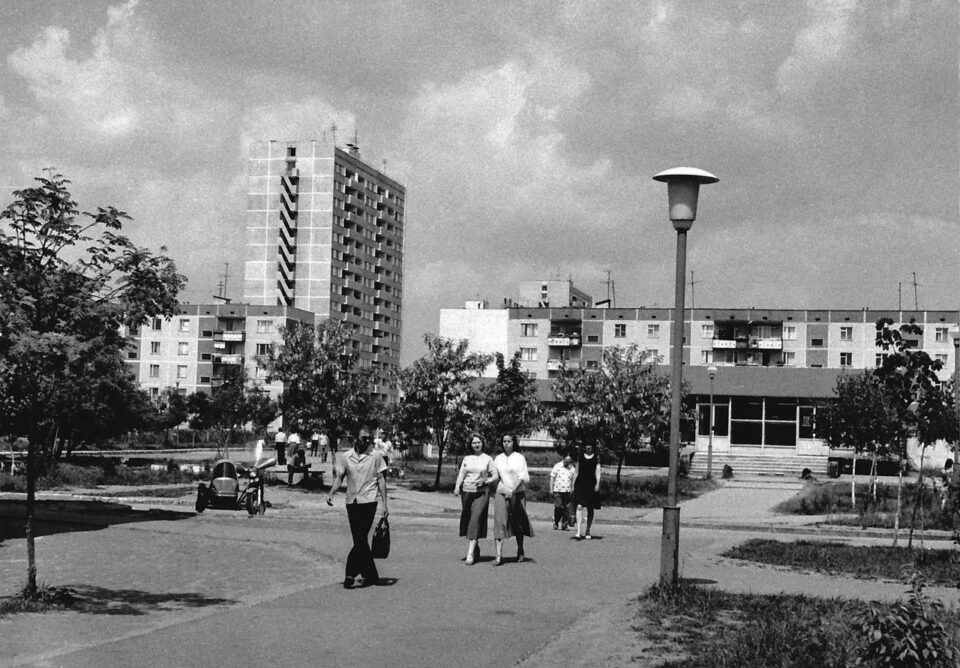
Even now, I would happily move back to live in Pripyat – it was that interesting there… Even after the evacuation, I remember the city with warmth
Tatyana Rosetskaya, evacuated from Pripyat at 16
The authorities planned to keep expanding the city: to build new microdistricts, raise the population to about 80,000 people and turn Pripyat into a major tourist and recreation centre. By 1986, it was one of the youngest and “most progressive” cities in the Soviet Union, marked by an atmosphere of engineering optimism and shared happiness. It was precisely this image – a modern, vibrant and joyful city – that was abruptly cut short by the tragedy of the spring of 1986.
Chernobyl disaster and the story of evacuation
In the night from 25 to 26 April 1986, an experiment was carried out at the Chernobyl Nuclear Power Plant to test emergency power systems. A wrong sequence of actions, design flaws in the reactor and violations of safety protocols led to an uncontrollable surge in power, a reactor explosion and a fire that lasted for several days. As a result of the explosion of the fourth reactor, huge amounts of radioactive material were released into the environment.

By IAEA Imagebank – 02790015, CC BY-SA 2.0, https://commons.wikimedia.org/w/index.php?curid=63251598
In the first hours after the accident, no one understood the real scale of the danger. Firefighters and liquidators were extinguishing local fires while the radioactive plume was carried by the wind to the north and west, over parts of Belarus, Ukraine and Russia. The authorities initially tried to avoid panic: information spread slowly, and many residents of Pripyat continued their ordinary routines the following day.
We heard there was a fire at the plant, but we didn’t see it as something frightening. On the morning of 26 April, the children had their usual classes, everyone went shopping, walked outside…
Participant in the evacuation, oral history archive
The official announcement about a possible evacuation was made only around midday on 27 April. People were told that they would have to leave the city for just a few days, so most took only documents, money, a few personal belongings and minimal clothing. Columns of buses moved through the streets almost all day. Within just a few hours, Pripyat was empty.
We got on the bus, soldiers in masks were standing around the windows, and the city was growing quiet – strangely and frighteningly quiet. I couldn’t quite believe that this was my last morning in my home.
A.V., evacuated with her family
Over the course of 27 April, about 50,000 people were evacuated from the city. After the evacuation, Pripyat became part of the exclusion zone, closed to normal life and doomed to gradual decay. For many, the most painful memory was precisely this uncertainty and the illusion of a quick return that, as it turned out, would never happen. The disaster permanently changed people’s lives, cutting off not only their everyday routines but also their very sense of the future.
After the disaster: today’s Exclusion Zone
Today Pripyat and the area around the Chernobyl Nuclear Power Plant form part of the vast Exclusion Zone, a closed territory of more than 2,600 square kilometres between Ukraine and Belarus. For almost forty years, time seems to have stopped here: abandoned apartment blocks, flooded basements, schools with books still lying on desks, a broken Ferris wheel and overgrown streets now walked only by tourists and researchers. The ruins of Pripyat look strikingly photogenic and frightening at the same time: nature is slowly reclaiming the city, trees grow through the asphalt, and wild animals search for space among the remnants of human buildings. The abandoned structures have become symbols of their era – a visual reminder of what happens when people leave and a city is left alone with history and radiation.
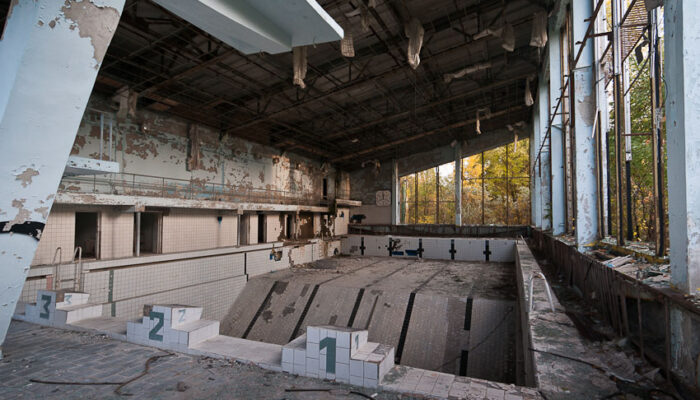


Excursions, photography and drones reveal how this landscape has changed over the decades. Many researchers speak of a phenomenon of an “empty civilisation”, where traces of life remain almost untouched.
In Pripyat we saw wallpaper still on the walls, children’s toys, flowers on balconies – everything remained the way it was at the moment of evacuation.
from a researcher’s field report
At the same time, radiation levels in some places have dropped enough for wildlife to return: wolves, elk and even horses. Among those who were evacuated, there were also people who decided to come back to their homes years later. They are known as “self-settlers” – people who returned to villages inside the Exclusion Zone despite bans and danger.
I left the village in April 1986, but a year later I came back. Being without my home was impossible – my parents are buried here, everything of mine is here.
Maria Stepanovna, self-settler, oral history archive
Self-settlers rebuilt their lives in abandoned and often half-ruined houses: they planted gardens, kept livestock and maintained old local traditions. Many of them still receive food and medicine from researchers, undergo regular health checks, yet refuse to move away even today.
Over time, Pripyat and Chernobyl have inspired numerous legends – about ghosts, wild animals with “radiation” forms, disappearing objects and the spirits of people who could not leave their homes behind.
An old man said that every spring brings new voices into the abandoned city. He believes that the memory of the city will last as long as someone comes here to remember.
eyewitness, oral history project “Zona”
A separate chapter in the zone’s mythology concerns the “stalkers”: people who deliberately enter the Exclusion Zone to seek intense experiences, study the ruins, shoot films or photos, and sometimes even stay for several days. Contemporary stalkers include romantics, researchers and thrill-seekers, with their own rules, traditions and stories. Many of them believe that the zone is alive, endowed with its own kind of consciousness, and does not always let outsiders in.
The Exclusion Zone has become an important subject for researchers, documentary makers and digital humanities projects. Through archives, blogs, virtual tours and photographic projects, Pripyat and Chernobyl have gained a second life in digital memory. The slow decay, the return of nature and the fading post-Soviet architecture have become symbols of remembrance and a reminder of how quickly a human world can disappear once it is abandoned. But the disaster transformed more than just Pripyat – it permanently entered the lives of the surrounding regions, including the Bryansk region where I come from.
Impact on Bryansk
The Bryansk region became one of the worst‑affected territories in Russia after the Chernobyl disaster. Radioactive fallout covered the southern and south‑western districts, such as Klimovsky, Krasnogorsky and Novozybkovsky, where contamination by caesium‑137 and strontium remained above safety norms for many years. The authorities introduced regular checks of food, restrictions on mushrooms, milk and berries, sanitary treatments and special radiation screenings in schools. Many residents remember queues for baby food, relocation to “clean zones”, a constant sense of anxiety and endless conversations about an “invisible danger” – radiation.

I conducted an interview with one of my mother’s friends, who grew up in the Bryansk region and still remembers those years very clearly, even though she was only nine years old when the disaster happened.
Personal memories: Antonina, born in Krasnaya Gora (Bryansk region)
Q: What do you remember most from the time after the accident?
“I was born and grew up in the village of Krasnaya Gora. I remember the feeling that something terrible had happened, but for a long time nobody really understood what was going on. Suddenly there were restrictions on many products, we were forbidden to take cows out to pasture, and doctors kept coming to examine us.”Q: How did everyday life change for children?
“Before the start of the school year we were invited for check‑ups ‘because of the radiation’. School yards were washed down from trucks, and food at the market was checked – it became the new normal. In the village everyone was worried: children were often ill, a neighbour was diagnosed with a rare thyroid disease, and the grandmothers kept talking about ‘Chernobyl diagnoses’.”Q: Were there any restrictions on nature and local food?
“We were told not to eat local produce and not to swim in the rivers. In the end, many children were sent away to stay with relatives or friends in ‘cleaner’ places. I spent several months away from my family and friends, and that was horrible. Later the anxiety slowly faded, people began to return home, but that first shock stayed with us.”Q: Did anything come from the government response?
“If you can call it a ‘plus’, people in our region started receiving food supplies – products that were normally hard to buy. Our diet was controlled, and, in a strange way, we did not experience the same food shortages in the 1990s that many other regions of Russia did.”
Her memories echo many official reports about increased health risks and long‑term anxiety in the Bryansk region…
This anxiety quietly entered both family and collective memory. People told stories about closed home villages, relatives who had to move far away, and the fear of having children. For some, a new life began with leaving and the impossibility of ever returning home.
One of the major consequences for Bryansk was radioactive fallout that affected not only land and forests but also rivers and lakes. The Desna River and other waterways in the region received significant radioactive contamination, which influenced water quality, fish and the wider environment for decades. Many residents grew vegetables and fruit in their gardens, caught fish and collected mushrooms and berries – all of which could quietly become dangerous because of accumulated radionuclides.
The sky looked purple for several days, It was a strange kind of glow, and even before people knew what had happened, many had a strong feeling that something was terribly wrong. After we were not allowed to go outside when it rained, and many people felt unwell for a while.
My mam and dad
The ecological impact quickly translated into a deterioration in public health. The region saw increases in cancer rates, thyroid and immune system disorders, as well as health problems among children born in the years after the accident.
Chernobyl has become part of regional identity. In Bryansk, local memorials appeared, schools held “Chernobyl lessons”, and the book of remembrance grew with the names of liquidators. At the same time, the image of the Exclusion Zone, the myths surrounding it and stories of resettled people became an integral part of local culture – from family conversations to literature and informal communities.
Digital memory
With every year, the memory of Chernobyl moves further into digital space. Large online archives now document not only the disaster itself but also life before it, the experiences of evacuees and the stories of liquidators. One of the most significant resources is the archive 1986.org.ua, which brings together eyewitness testimonies, photographs, documents, videos and a detailed map of resettled villages in the Exclusion Zone. Svetlana Alexievich’s book Chernobyl Prayer has gained international recognition; it is based on hundreds of interviews with residents of Pripyat, Bryansk, liquidators and displaced people, and has inspired projects such as Voices from Chernobyl, which translates and publishes oral histories in multiple languages.
Online communities also play a crucial role. There are Facebook groups like “Chernobyl: Before and After”, the Russian forum chernobylplace, and YouTube video archives such as Lost Films of Chornobyl, which host unique recordings of excursions, conversations with self‑settlers and virtual walks through Pripyat. Visual memory is supported by digital museums – for example, the interactive Chernobyl Museum, online collections of Soviet‑era photographs and projects that reconstruct Pripyat’s urban layout using 3D modelling. Many contemporary researchers use tools like Zotero and Mendeley to organise archival sources, create public “Books of Memory”, map radioactive fallout, and conduct crowdsourcing initiatives and online interviews.
Final reflections
The Chernobyl disaster is a tragedy that has left a deep mark not only on ecology and health, but also on the collective and personal memory of entire regions. For the residents of Pripyat and Bryansk, for liquidators, displaced people and their families, this experience has become part of their identity, shaping how they relate to both past and present. The loss of a city, the disappearance of everyday life, trauma and constant anxiety cannot be captured in a single phrase or date. Only through personal stories, oral testimonies, old photographs and family archives does it become clear how complex and many‑layered people’s lives were after 1986.
Digital humanities offer a unique chance to preserve these fragile stories and make them accessible to the world. Virtual archives, online projects, digital “books of memory” and interactive maps not only bring together scattered data but also add new voices, helping to rethink the tragedy and place it within contemporary dialogue. To remember Chernobyl means not only to read documents, but also to listen to people. The strength of digital technologies lies in their ability to preserve and transmit the experiences of those who lived through loss, making this history a living part of the twenty‑first century. In the end, the memory of the Chernobyl zone, of Bryansk, of vanished towns and disrupted lives is not just an archival fact – it continues to live in online communities, in new projects and in individual recollections, leaving space for understanding and dialogue about both past and future.