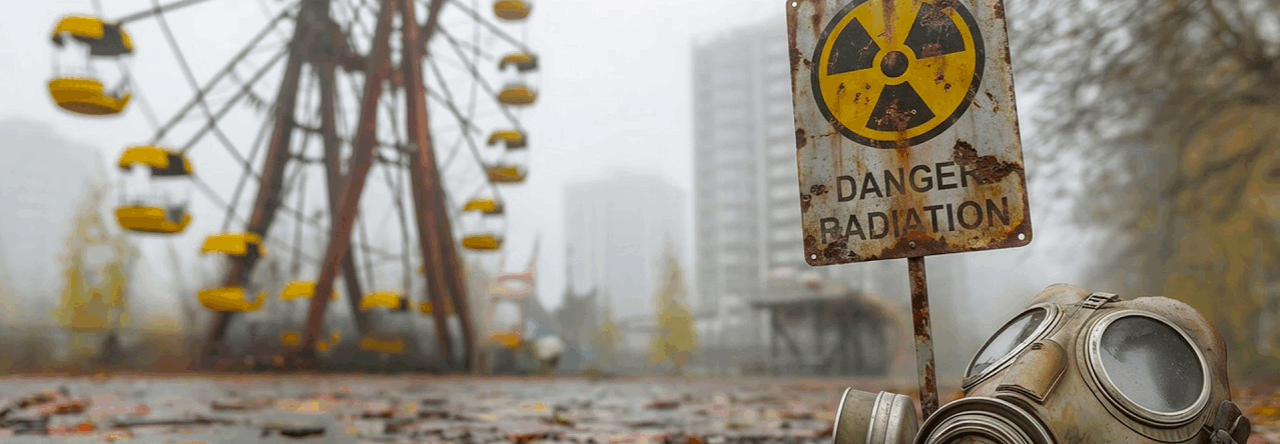
Pripyat is a ghost city built in 1970 to house workers of the Chernobyl nuclear power plant. After the 1986 explosion, it was evacuated and abandoned, becoming a powerful symbol of loss and one of the twentieth century’s greatest tragedies.
I come from the Bryansk region, where Chernobyl’s history is deeply personal. Families lived under food restrictions and constant health monitoring, and memories of that time remain embedded in everyday life.
As years pass, these voices begin to fade. This blog post brings together official records and personal narratives to preserve them, showing how digital technologies can do more than document vanished cities.
Pripyat before 1986
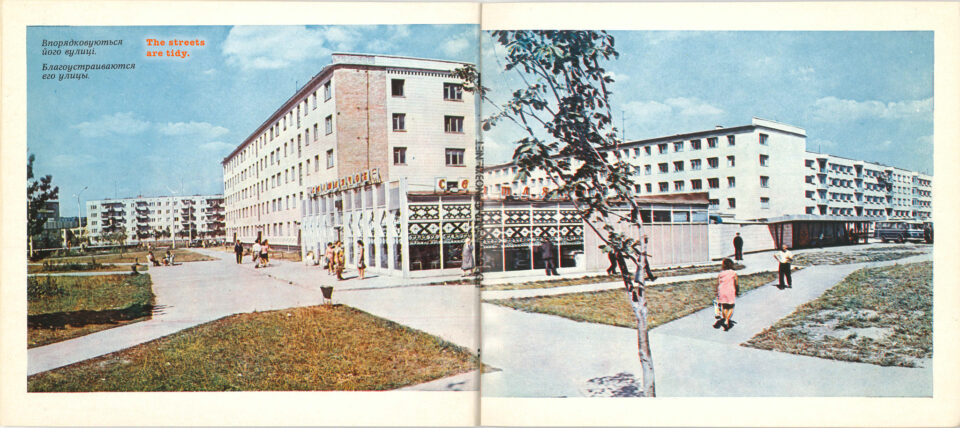
Founded in 1970 near Chernobyl, Pripyat was designed as a model Soviet city: modern, functional, and bright. Built for plant workers and their families, it offered comfortable apartments, good salaries, schools, cultural centres, and recreational spaces including an amusement park and riverside promenade.
Dozens of photographs from the Soviet period show clean streets, smiling children, public celebrations, parades, opening ceremonies. In the memories of residents, Pripyat was perceived as a city of the future.


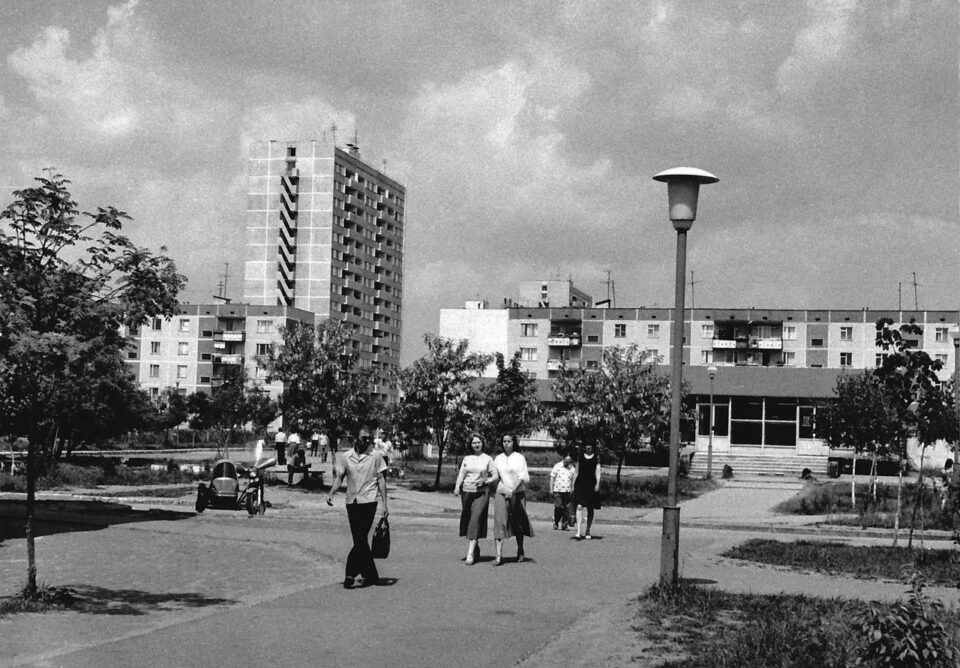
Even now, I would happily move back to live in Pripyat – it was that interesting there… Even after the evacuation, I remember the city with warmth
Tatyana Rosetskaya, evacuated from Pripyat at 16
The city was expanding rapidly, planned to reach 80,000 residents and become a major tourist destination. By 1986, it stood as one of the USSR’s youngest and most progressive cities, a place of shared engineering optimism. Then, in spring 1986, that promise was shattered.
Chernobyl disaster and evacuation
On the night of April 25–26, 1986, what was meant to be a routine safety test at the Chernobyl Nuclear Power Plant turned into a disaster. A chain of human mistakes, flawed reactor design, and ignored safety rules led to a sudden power surge, a violent explosion, and a fire that burned for days, sending vast amounts of radioactive material into the air.

By IAEA Imagebank – 02790015, CC BY-SA 2.0, https://commons.wikimedia.org/w/index.php?curid=63251598
In the first hours after the accident, no one understood the real scale of the danger. Firefighters rushed to put out the flames, unaware of the invisible danger around them, while a radioactive cloud slowly drifted across Belarus, Ukraine, Russia, and Europe. Officials tried to minimize the threat, and life in Pripyat went on as usual. People went to work, and children played outside.
The official announcement about a possible evacuation was made only around midday on 27 April. Residents were told it would be temporary, just for a few days. They packed in a hurry, taking documents, some money, and a few personal things. By evening, nearly 50,000 people had left the city in long lines of buses.
We got on the bus, soldiers in masks were standing around the windows, and the city was growing quiet – strangely and frighteningly quiet. I couldn’t quite believe that this was my last morning in my home.
Nadezhda Petrovna, evacuated with her family
Pripyat was left behind as a silent, empty place. For those who fled, the hardest part was believing they would return. They never did. The disaster did not just destroy a city. It quietly took away an entire future.
After the disaster: today’s Exclusion Zone
Today Pripyat and the area around the Chernobyl Nuclear Power Plant are part of the Exclusion Zone, a closed territory on the border of Ukraine, Russia and Belarus. Almost forty years later, it feels as if time has stopped there. Empty apartment blocks, schools with books still on desks, a broken Ferris wheel and streets slowly taken over by trees remain frozen in place.
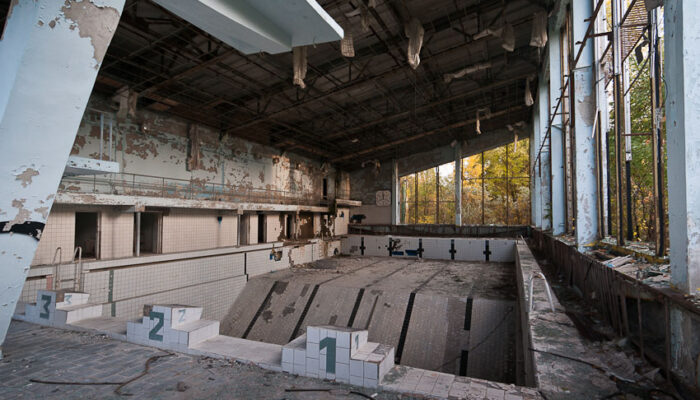


Excursions, photography and drones reveal how this landscape has changed over the decades. Many researchers speak of a phenomenon of an “empty civilisation”, where traces of life remain almost untouched.
At the same time, radiation levels in some places have dropped enough for wildlife to return: wolves, elk and even horses. Among those who were evacuated, there were also people who decided to come back to their homes years later. They are known as “self-settlers” – people who returned to villages inside the Exclusion Zone despite bans and danger.
Over time, the zone has given rise to myths, from ghost stories to tales of “stalkers” who secretly enter the area to explore, film and photograph the ruins. For many, the zone feels alive, as if it has its own will.
Moreover, the disaster shaped not only Pripyat but also the surrounding regions, including the Bryansk region where I come from.
Impact on Bryansk
The Bryansk region was among the areas in Russia most affected by the Chernobyl disaster. Radioactive fallout reached the southern districts, including Klimovsky, Krasnogorsky and Novozybkovsky. For many years, contamination remained above safe levels. Food was checked, local produce was restricted, and schools introduced medical examinations. People remember queues for baby food, relocation to “clean zones” and constant anxiety about an “invisible danger”, radiation.

I interviewed one of my mother’s friends who grew up in the Bryansk region and remembers those years well.
Personal memories: Antonina, born in Krasnaya Gora (Bryansk region)
Q: What do you remember most from the time after the accident?
“I was born and grew up in the village of Krasnaya Gora. I remember the feeling that something terrible had happened, but for a long time nobody really understood what was going on. Suddenly there were restrictions on many products, we were forbidden to take cows out to pasture, and doctors kept coming to examine us.”Q: How did everyday life change for children?
“Before the start of the school year we were invited for check‑ups ‘because of the radiation’. School yards were washed down from trucks, and food at the market was checked – it became the new normal. In the village everyone was worried: children were often ill, a neighbour was diagnosed with a rare thyroid disease, and the grandmothers kept talking about ‘Chernobyl diagnoses’.”Q: Were there any restrictions on nature and local food?
“We were told not to eat local produce and not to swim in the rivers. In the end, many children were sent away to stay with relatives or friends in ‘cleaner’ places. I spent several months away from my family and friends, and that was horrible. Later the anxiety slowly faded, people began to return home, but that first shock stayed with us.”Q: Did anything come from the government response?
“If you can call it a ‘plus’, people in our region started receiving food supplies – products that were normally hard to buy. Our diet was controlled, and, in a strange way, we did not experience the same food shortages in the 1990s that many other regions of Russia did.”
Her memories reflect long term anxiety shared by many families in the region. Stories of abandoned villages, forced relocation and fear for the future became part of everyday life.
And, as my parents, both doctors, have told me, environmental damage led to long-lasting health problems, including elevated rates of cancer and thyroid disorders. Even today, these diseases remain very common among the people in my city
Over time, Chernobyl became part of Bryansk’s regional identity, marked by memorials, school lessons and the growing memory of those affected.
Digital memory
But how do these stories survive? Over time, the memory of Chernobyl has largely migrated to digital platforms. Archives have become our primary keepers of the past. One of the key resources is 1986.org.ua, which collects testimonies, photographs, documents, videos and maps of resettled villages.
Svetlana Alexievich’s Chernobyl Prayer, based on hundreds of interviews, has strongly influenced how these stories are remembered and shared, inspiring projects such as Voices from Chernobyl.
Online communities continue this work. Facebook groups like “Chernobyl: Before and After”, the forum chernobylplace and YouTube archives such as Lost Films of Chornobyl share rare footage, personal stories and virtual walks through Pripyat. Digital museums and interactive projects further support visual memory through photographs, maps and 3D reconstructions.
Analyzing Keywords and Themes
To understand what these stories mean, I analyzed the text using the Voyant tool. Rather than reading individual sources closely, this method reveals broader patterns. The word cloud below visualizes the most frequently used terms:
This visualisation shows that the memory of Chernobyl is structured around interconnected concepts such as memory, city, disaster, people, time and digital preservation. The prominence of words like memory and digital indicates that, in the twenty first century, remembering Chernobyl is closely tied to technological mediation.
Final reflections
The Chernobyl disaster left a deep mark on the environment, public health, and collective memory. The loss of a city and the disruption of everyday life cannot be reduced to a single event. Memory emerges through recurring language and shared themes that return across different narratives and platforms.
At the same time, digital sources are never neutral. Digital archives are curated spaces shaped by selection, classification and visibility. Search algorithms further influence which stories circulate widely and which remain marginal. This perspective aligns with the concept of digital hermeneutics, which recognises that digital tools do not simply preserve the past, but actively interpret it.
Chernobyl exists not only as a historical event, but as a continuously reinterpreted digital archive, shaped by technology, collective participation, and methodological choices. Understanding this process reveals how contemporary tools influence what is remembered and how memory is understood.